Kue Castella Jepang
Treat yourself to this moist and bouncy Japanese honey sponge cake called Castella. Prized for its delicate crumb and lightly sweet flavor, it's a beloved tea snack and a great hostess gift, too. Bake a perfect Castella Cake at home with my techniques and tips!
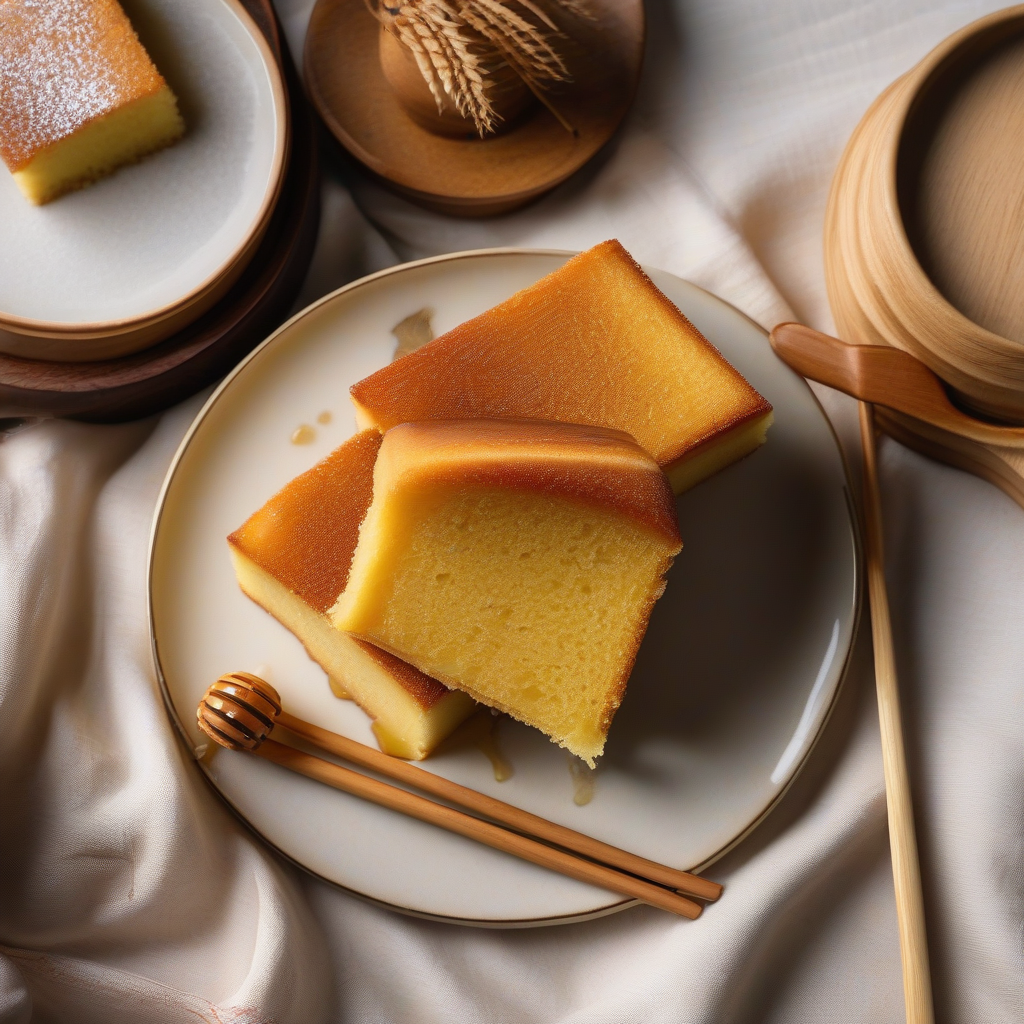 Foto: Just One Cookbook
Bahan-bahan
- 2 Tbsp water
- 3 Tbsp honey
- 1 Tbsp mizuame syrup (glutinous starch syrup)
- 100 g bread flour
- 3 large eggs (50 g w/o shell) ((at room temperature—very important!))
- 100 g sugar ((½ cup))
- ½ Tbsp white sparkling sugar
Langkah-langkah
Please note that this recipe requires a chilling time of 12 hours or overnight.I highly encourage you to weigh your ingredients using a kitchen scale. For weights, click the Metric button above. If you‘re using a cup measure, please follow the “fluff and sprinkle“ method: Fluff your flour with a spoon, sprinkle it into your measuring cup, and level it off. Otherwise, you may scoop more than you need.
Gather all the ingredients. The eggs must be at room temperature. Preheat the oven to 350ºF (180ºC). *Please see my latest update in the Notes below regarding the oven temperature. For a convection oven, reduce the oven temperature by 25ºF (15ºC) to 325ºF (165ºC). Prepare a spray bottle with water, an offset spatula, and a bamboo skewer. Use a 1 lb baking pan that is light-colored for the best outcome.
On your work surface, place a sheet of parchment paper that‘s 13 x 16 inches (30 x 40 cm). Set a 1 lb loaf pan on top (I use a light-colored 1 lb loaf pan that‘s 8½ x 4½ x 2¾ inches or 22 x 11 x 7 cm). Mark the four corners of the loaf pan on the paper. Fold and crease the paper on all four sides following the corner marks.
Unfold the paper so that the long side of the creased rectangle is in front of you. On the two crease lines pointing toward you, cut slits up to the rectangle‘s left and right corners. Rotate the paper and cut two slits on the opposite long side. You will have four slits total. Then, place the paper in the baking pan, folding and layering the flaps to fit.
Cut a slit in each of the corner flaps down to the top edge of the pan. Then, fold down the paper over the pan‘s edges.
Secure the folded paper onto the edges with stainless steel clips to keep the lining from moving when you mix the batter during baking.
Combine 2 Tbsp water and 3 Tbsp honey in a small bowl. Then, add 1 Tbsp mizuame syrup (glutinous starch syrup). It‘s super sticky and extremely thick, so use a mini spatula to scrape it from the measuring spoon.
Take your time to dissolve the mizuame. Press down and mash the mizuame with the mini spatula to facilitate dissolving. Do not microwave the mixture as we do not want to increase the temperature of the batter. Set aside.
Sift 100 g bread flour with either a sifter or fine-meshed strainer. Hold the strainer‘s handle with one hand as you gently tap the strainer with the other, and the flour will gradually sift through. Tip: Why bread flour? That's what's traditionally used, and it gives the cake an elastic, bouncy texture that you cannot achieve with all-purpose flour.
In the bowl of a stand mixer, crack 3 large eggs (50 g w/o shell) that are at room temperature. Add 100 g sugar.
Fit a stand mixer with the whisk attachment and vigorously beat the eggs and sugar on high speed (Speed 8/10) for 3–5 minutes without stopping. If you beat the eggs with a handheld mixer, it will take more time.
The beaten eggs will quadruple in volume and have a thick texture and pale yellow color.
When you stop the mixer and lift the whisk attachment, the mixture should fall in ribbons.
Gradually add the honey mixture to the batter while whisking on low speed (Speed 2) until combined, about 30 seconds.
Gradually add the bread flour while whisking on low speed (Stir) until just combined, for about 30 seconds. Do not overmix.
When the flour is just combined, stop whisking. When you lift the whisk, the batter should fall in ribbons.
Using a silicone spatula, scrape the batter from the bowl‘s sides and bottom and gently fold the batter a few times. Next, sprinkle ½ Tbsp white sparkling sugar on the bottom of the lined pan. This sugar will add a crunchy texture to the cake‘s bottom and help retain moisture.
Pour the batter into the cake pan in just one spot. This helps to minimize air pockets and smooth the top of the batter. Tip: If your pan is smaller than mine, you‘ll need to add the excess batter to another smaller pan and use a shorter bake time.
To level the batter and help remove air pockets, hold the cake pan 2 inches above the counter and drop it flat onto the counter. Then, draw a zigzag line through the batter with a bamboo skewer to further eliminate air bubbles.
Place the cake pan on the middle rack of the preheated oven at 350ºF (180ºC). Close the oven door and set a timer for 2 minutes.
After the 2-minute timer beeps, reset the timer to 1 minute and complete the following several steps within the next minute (Ideally, within 30–40 seconds, so you can close the oven door ASAP). First, open the oven and spray twice above the cake batter with the spray bottle.
Next, use an offset spatula to quickly mix and circulate the batter 15 times from the left side, without touching the sparkling sugar at the bottom of the pan. This mixing technique, called awakiri (泡切り, “bubble cut“) in Japanese, helps to remove air pockets and even out the batter‘s temperature so the cake rises evenly without cracking.
Finally, quickly mix and circulate the batter 15 times from the right side. Shake off the excess batter from the spatula and close the oven door. Reset the timer to 2 minutes. Repeat this process (Step 2 to Step 4) 3 more times.
On the 4th and final time, after you finish the mixing process, remove the stainless steel clips. Run the bamboo skewer through the batter. If any of the clips were submerged in the batter, fill in the clip marks in the batter with the skewer.
Spray water into the oven, then continue to bake for another 30–40 minutes.
The cake is done if it bounces back when you touch it with your finger. Tip: If your cake top looks wrinkled or cracked, you may have overbaked it. Next time, check earlier to see if it‘s done. If the top is lighter in color and sticky, you may have underbaked it. Next time, you need to increase the oven temperature. I highly encourage you to check your actual oven temperature with an oven thermometer to see if it‘s running hotter than the display setting and adjust accordingly.
Remove the castella from the oven. To help prevent shrinkage, drop the pan twice onto the countertop to release the steam vapors from the cake. Next, invert the cake from the pan onto a nonstick silicone mat (I use Silpat and highly recommend it). Leave the parchment paper in place. Leave it upside down and let it cool to room temperature, about 45–60 minutes. Tip: I found that a nonstick silicone mat works perfectly here, as parchment paper may stick to the cake. However, if your cake sticks to the silicone mat, you may have underbaked it. Next time, increase the oven temperature or bake it a few minutes longer. Also, check your actual oven temperature to see if it's running cooler than the display setting and adjust accordingly.
Once cooled, immediately wrap the cake with its parchment paper in plastic wrap to retain moisture. Then, put the wrapped cake in the refrigerator and store overnight (8–12 hours). This will help the cake develop a fine and moist texture.
Remove the cake from the refrigerator. Discard the plastic and carefully peel off the parchment paper.
Now, we‘ll trim the sides of the castella to expose the yellow body of the cake. First, slice off the crust from the two long sides of the cake with a sharp bread knife (I highly recommend using a Suncraft bread knife). Use a damp towel to wipe off the crumbs from the blade after every cut. Tip: These castella crusts are moist and delicious to snack on!
Then, slice off the crust from the two short sides of the cake. Do not trim the top and bottom of the cake. Cut the cake crosswise into slices about ¾ inch (2 cm) thick. You will get 8–9 slices total.
Serve it with tea or coffee, if you‘d like. Enjoy!
To save for later, wrap individual pieces with plastic wrap. Store for up to 3–4 days at room temperature, 5–7 days in the refrigerator, and 1 month in the freezer.
Memuat komentar...