Easy Homemade Tofu
If you've never enjoyed freshly made Japanese tofu before, you're in for a treat. Learn How to Make Tofu at Home for smooth, delicious, and easy homemade tofu from scratch. With just three all-natural ingredients, it's better than store bought!
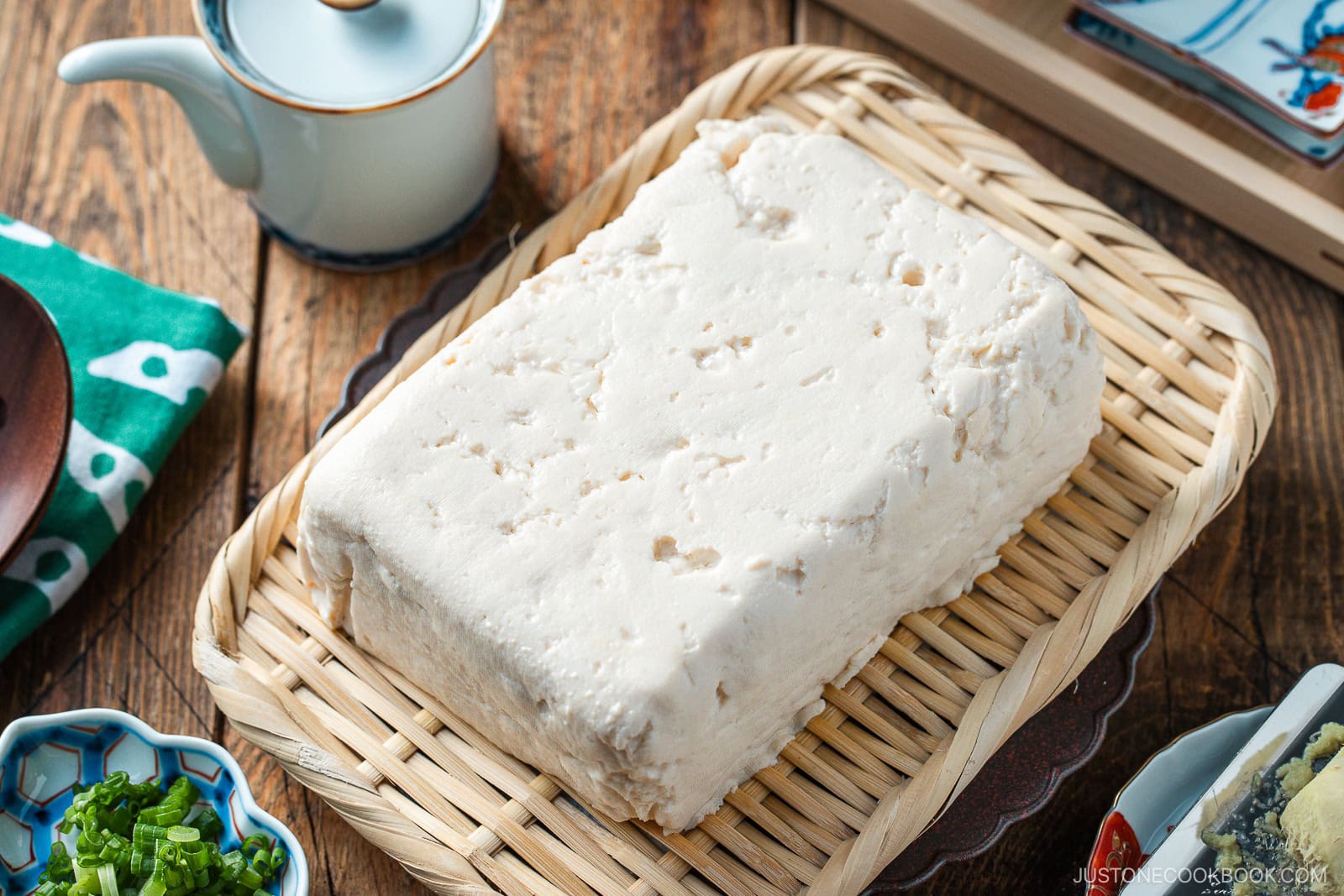 Foto: Just One Cookbook
Bahan-bahan
- 2 cups soybeans ((dried))
- 8 cups water ((for soaking; use 4–5 times the volume of the dried beans))
- 6½ cups water ((for blending; use 2.3 times the weight of the rehydrated beans))
- 2 tsp liquid nigari (bittern)
- 2 tsp lukewarm water ((for the nigari))
Langkah-langkah
-
Gather the ingredients. Remove any discolored or damaged soybeans.
-
Rinse 2 cups soybeans several times until the water runs clear and drain well. Soak in 8 cups water (4–5 times their volume of water) in a large bowl or stock pot. The beans will swell to about three times their original size. Soak times: 8–9 hours in summer (68–77ºF, 20–25ºC); 15 hours in spring/fall (50–59ºF, 10–15ºC); or 20 hours in winter (32–41ºF, 0–5ºC). Nami's Tip: Give them plenty of soaking time so they blend smoothly and release more milk.
-
Check if the beans are ready. When they're soft enough to crush between your fingers and split in half, they're done soaking. Drain well. Then weigh your beans. Mine weighed 672 g. Multiply the weight by 2.3 to calculate the amount of blending water. In my case, 672 x 2.3 = 1546, so I'll use 1546 ml (6½ cups) of blending water. *Why 2.3? See my Recipe Notes.
-
Bring a pot of water to a boil, then boil the straining bag and finishing cloth for 5 minutes to disinfect. You can also disinfect the strainer.
-
Line a strainer with the sanitized straining bag. Then, place the strainer over a deep bowl (I use a 5-qt KitchenAid glass bowl).
-
Next, you will blend the beans and the measured blending water. Depending on your blender's size, you need to run in batches. Since you cannot introduce additional water, it's crucial to divide the water carefully.Also, it's a smart idea to reserve about 1 cup of blending water to clean the blender after the final batch.
-
Add half of the beans and half the water to a high-performance blender (or one-third of each if using a standard blender). Nami's Tip: The mixture will foam up, so fill the carafe no more than two-thirds full.
-
Purée until smooth, about 1½ minutes on a medium setting (or 2 minutes for the standard blender).Nami's Tip: The smoother you blend, the more soy milk you'll get—and the silkier your tofu will be.
-
Transfer it to a large pot (6 quarts or larger). Then, blend the other half of the beans and water (or continue with 2 more batches for the standard blender).
-
After the final batch, use the reserved 1 cup of blending water to rinse out the purée from the blender and add it to the pot. Be sure to use all the measured blending water. Nami's Tip: This blended raw mixture is called namago in Japanese. The namago will foam up as it cooks, so use a pot with plenty of room.
-
Heat the mixture over medium-high heat, stirring gently with a wooden spatula and scraping the bottom of the pot to prevent sticking. Bring it to a gentle boil (about 200ºF or 93ºC), then turn off the heat. Otherwise, it will quickly overflow.
-
Let the foam settle for 1–2 minutes. Then, turn the stove back on to low and cook gently for 8–10 minutes, stirring the bottom of the pot constantly to prevent burning. Turn off the heat and remove the pot from the stove.
-
Pour the cooked mixture into the strainer lined with the sanitized bag.
-
To speed up straining, press gently with a ladle or spatula while still hot. Nami's Tip: We strain the soy pulp while it’s still hot because it makes the process smoother and safer. When hot, more flavor and protein are released, so you get better soy milk. It also prevents bacteria from growing, which can happen if the mixture cools down too much. Plus, the hot pulp is softer, so the liquid separates more easily and gives you a silky, smooth soy milk.
-
Once you finish draining the mixture with the ladle or spatula, gather the cloth bag.
-
Wash and cool your hands, then squeeze out the remaining soy milk by hand. For a standard tofu size (wooden box), you will need a minimum of 4⅛ cups (1000 ml) of soy milk.
-
If any foam remains in the soy milk, skim it off or strain it again for a smoother tofu texture.
-
You now have soy milk and soy pulp, okara. Store the leftover okara in the refrigerator or freezer for other recipes like my Okara (Unohana) – Simmered Soy Pulp & Vegetables.
-
Measure exactly 4⅛ cups (1000 ml) of soy milk. Heat it in a medium pot over low heat until it reaches 170ºF (75ºC). I use an instant-read thermometer. Keep it at that temperature for 2 minutes, then turn off the heat.Nami's Tip: If the soy milk is too cool, the tofu won't set; if it's too hot, it will become too firm.
-
Mix 2 tsp liquid nigari (bittern) with 2 tsp lukewarm water in a small bowl. Pour half of the prepared nigari slowly over the soy milk, guiding it with a wooden spatula.
-
Gently stir two figure-8 motions with the wide side of the spatula. Cover and let it sit for 3 minutes. Nami's Tip: Do not overmix, or the tofu will become too firm. After adding nigari, cover the pot to keep the mixture warm, let it set quietly, and prevent the surface from drying out.
-
Pour in the other half of the nigari the same way. Gently stir four figure-8 motions. Cover with the lid and let it sit for 15 minutes. Then, start preparing the tofu box.Nami's Tip: While waiting, make sure the temperature doesn’t drop below 158ºF (70ºC). If it’s too low, the tofu won’t set; if it’s too high, it will turn out firm. If the temperature has dropped, bring it back to 170ºF (75ºC).
-
Soak the tofu mold in water to moisten thoroughly. Line the inside of the tofu mold with the sanitized finishing cloth, smoothing it tightly. Place a flat tray (I use my favorite prep tray) underneath to catch the draining liquid.
-
Check that the mixture has separated into soft curds and a clear puddle of liquid. If you do not see any clear liquid, then it has not fully separated. If this happens, draw one more gentle figure-8, let it rest another 5–10 minutes, and check again.If nothing changes, first check the temperature. If the temperature is fine, add a little more nigari.
-
Scoop the coagulated curds carefully into the lined tofu box.
-
Fold the cloth over the top and place the pressing lid on top.
-
Place a weight (425 g or a bit less than 1 lb) on the lid. Press for about 30 minutes for medium-firm tofu. Nami's Tip: If the weight is too heavy, the tofu will be overly firm.
-
Submerge the entire tofu box in a large bowl of cold water (add ice if it's hot). Carefully remove the mold, keeping the tofu wrapped in the cloth. Soak the wrapped tofu for about 30 minutes, changing water a few times. Nami's Tip: Soaking removes the nigari's bitterness and firms up the tofu. If it's still soft after 30 minutes, add more ice and soak another 10 minutes.
-
Carefully unwrap the tofu.
-
Remove it from the water. I transfer it to an airtight container.
-
Fill it with water. Your homemade tofu is best enjoyed about 4 hours after it's made.Nami's Tip: The tofu needs time to set fully and release excess moisture. Right after pressing, the tofu may still be warm and slightly unstable in texture. As it rests, it cools, firms up, and the flavors settle, giving you that delicate yet cohesive tofu texture. It's best consumed the same day.
-
Discard the water and it's ready to use!
-
Because it has no preservatives, homemade tofu should be enjoyed the same day for the best quality. However, if you'd like to store it, transfer the tofu to a container and cover with fresh water. You can refrigerate it for up to 1–2 days, but be sure to change the water every day. You can store the soy pulp (okara) in the fridge for 2–3 days or in the freezer for up to 1 month.
Estimasi Nutrisi (per porsi)
Makronutrien
*AKG = Angka Kecukupan Gizi berdasarkan diet 2.000 kalori
💰 Estimasi Harga
📋 Rincian Harga Bahan (20% bahan terdeteksi)
| Bahan | Jumlah | Harga Satuan | Subtotal |
|---|---|---|---|
| soybeans | 2 cups | - | - |
| water | 8 cups | - | - |
| water | 6.5 cups | - | - |
| liquid nigari | 2 tsp | Rp 140.000/kg | Rp 1.400 |
| lukewarm water | 2 tsp | - | - |
*Harga pasar perkiraan, bisa berbeda di daerah Anda












Memuat komentar...